Pioneer musician: Lian Yoong Ser


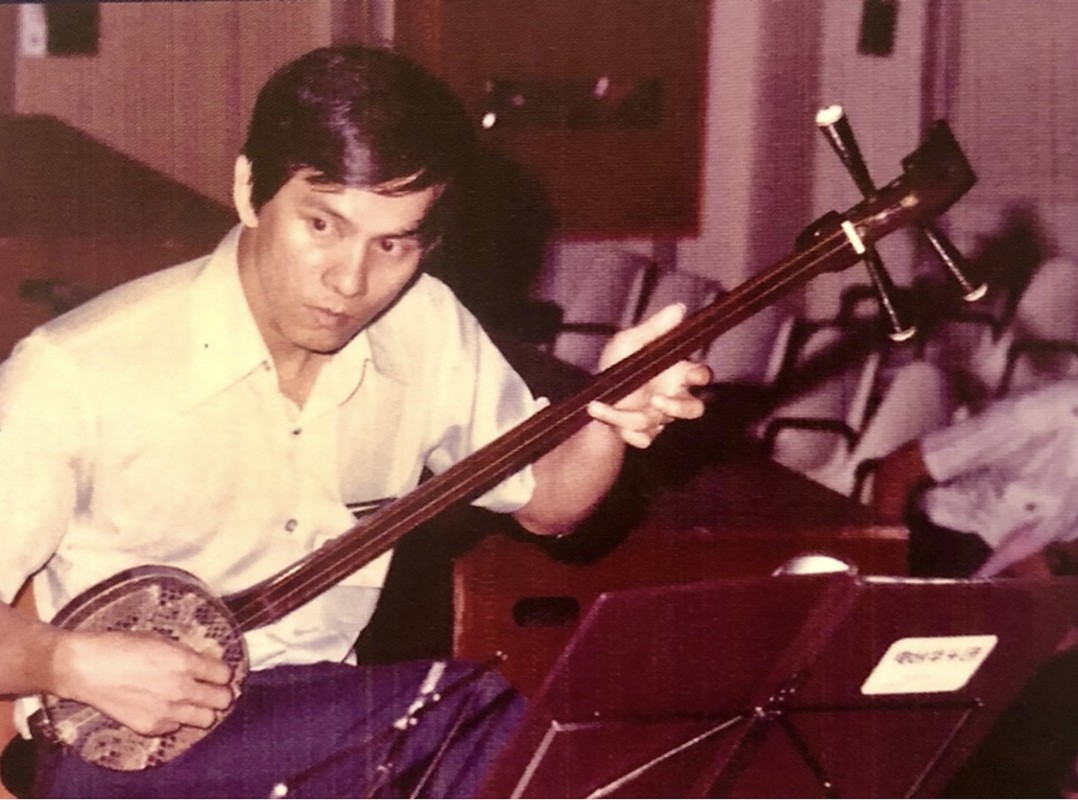
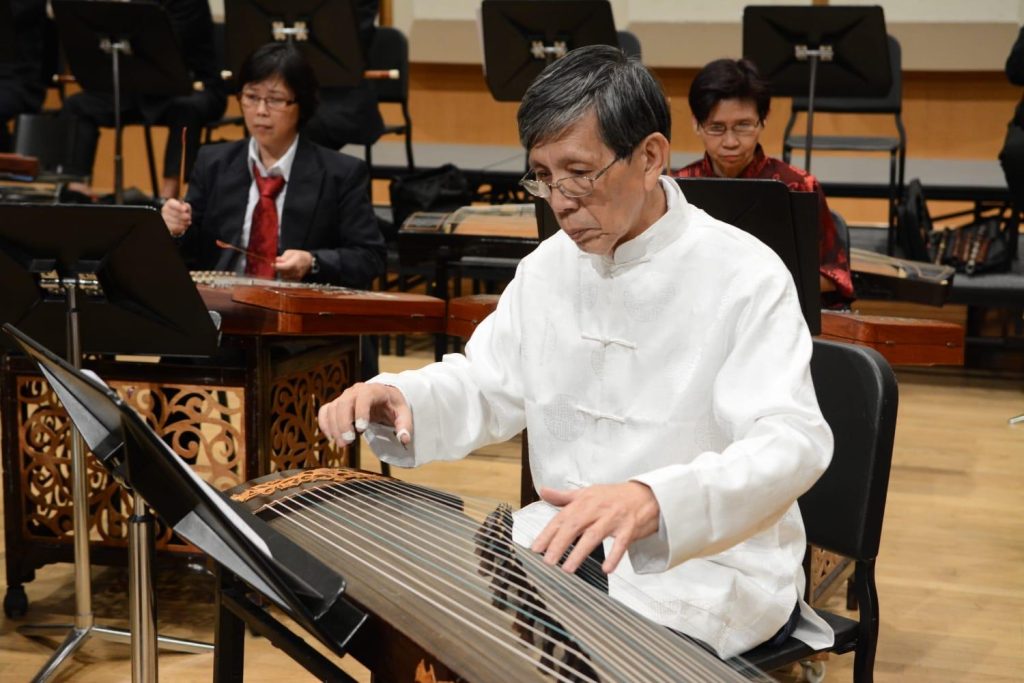
Lian Yoong Ser, born in 1938 in Singapore, is a pioneering Chinese orchestral musician known for playing the guzheng. His musical journey began with the Nanyang Khek Community Guild’s1 Traditional Music Ensemble (renamed Han Music Ensemble in 2003). From the age of nine, Lian watched the old masters from the Traditional Music Ensemble play Waijiang music (now known as Guangdong Han music) and perform Waijiang opera (now known as Guangdong Han opera) at the clan association’s celebrations. He began his musical studies under Liao Chaodong (birth and death years unknown) and He Changfu (birth and death years unknown), learning to play pieces such as San chuan (Tune of San Chuan) and Nan zheng gong (Tune of Nan Zheng Gong) on the tongzheng, a traditional 16-string steel zheng.
From Waijiang music to Chinese orchestral music
Lian took part in the musical activities of the Singapore Chinese Middle School Student Union, which was set up in 1953. The Student Union did not have many members then, and its musical activities were led by Huang Han Min (unknown–1961), the musical director of the Thau Yong Amateur Musical Association. He taught the participants Waijiang music, and they performed a repertoire of pieces such as Liu shui (Flowing Water), Shang tianti (Up the sky ladder), Pipa ci (Pipa Prose), and Nan zheng gong (Tune of Nan Zheng Gong). In 1959, Thau Yong set up a second ensemble that focused on Chinese orchestral music. It started with around 20 members and was led by Yeo How Jiang (1928–2017), who spent a few hundred dollars of his own savings to purchase instruments for the ensemble. For bass string instruments that could not be readily purchased, the group, which later grew to 30 to 40 members, made their own. On 4 August 1960, Thau Yong performed at the Victoria Theatre to raise funds for the National Theatre. This was a milestone in the early development of Chinese orchestral music in Singapore, and the programme for the evening featured guzheng solo pieces performed by Lian, including Yuzhou chang wan (Fisherman’s Song at Dusk) and Caiyun zhuiyue (Colour Clouds Chasing the Moon), as well as Xunyang ye yue (The Moon in Xunyang) and Jinshe kuang wu (Dance of the Golden Snake).
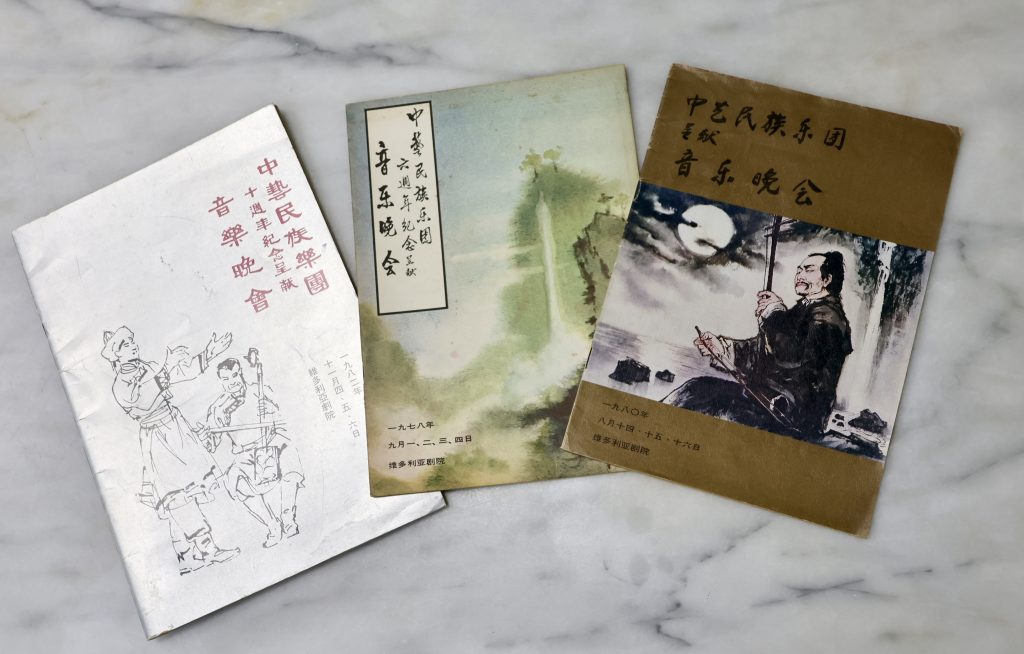
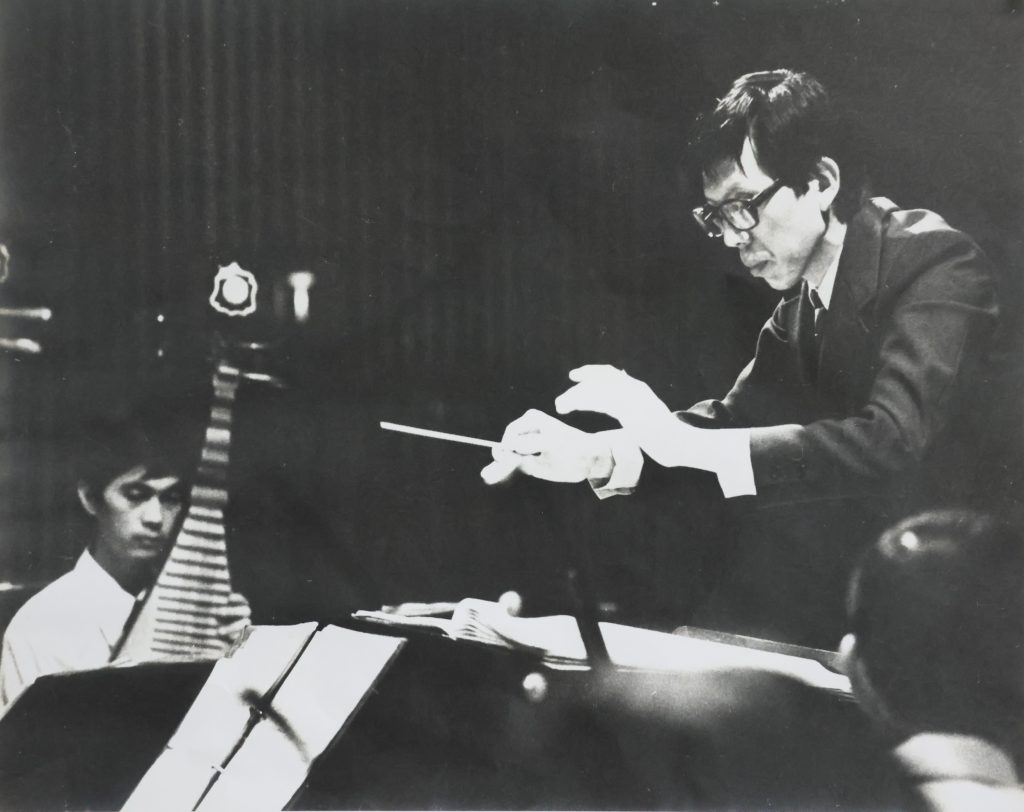
After the Chinese orchestra section of Thau Yong was disbanded in 1962, its musical instruments were transferred to the newly formed Kang Leh Musical Association. Lian remained active in the Chinese orchestral music scene and served as a conductor. One notable performance he led was the finale of a 1966 Chinese orchestra concert at the Victoria Theatre, Donghai yu ge (Fishermen’s Song of the Eastern Sea)2. In 1973, Lian founded the Zhong Yi Traditional Orchestra and served as one of its three conductors (the other two being Yap Yew Kei and Ang Lam Seng). He arranged Yisuo yiluo ji xintou (Remember Every Effort, 1978), and composed pieces such as Shan he song (Ode to Mountains and Rivers, premiere in 1975) and Jie (Calamity, premiere in 1980, renamed Nanyang zhige, Song of Nanyang in a later period). Shan he song and Jie were the largest-scale Chinese orchestral works at the time, with the use of a wide variety of instruments and a performance duration of close to 20 minutes. Zhong Yi Traditional Orchestra disbanded in 1987, after which Lian shifted the focus of his musical activities to the Nanyang Khek Community Guild. He led its newly established Chinese orchestra, which had 50 to 60 members at one point.

Musical growth
Although Lian was an amateur musician, he took his interest very seriously and was constantly honing his skills. Around 1963, he bought a cello at a flea market and began learning to play the instrument after restoring it. He studied with Foh Kim Hong (birth and death years unknown), a music graduate of the National Taiwan Normal University, and went on to attain the highest grade for cello awarded by the Associated Board of the Royal Schools of Music, Singapore. But he did not stop there and continued to study music theory and composition. In 1980, Lian furthered his studies at the Shanghai Music Conservatory. Over two decades, he learnt to play the new 21-string guzheng, as well as traditional and newly arranged zheng music from various parts of China, including Henan, Shandong, and Zhejiang.
Promoting the unique Han music of Nanyang Khek Community Guild
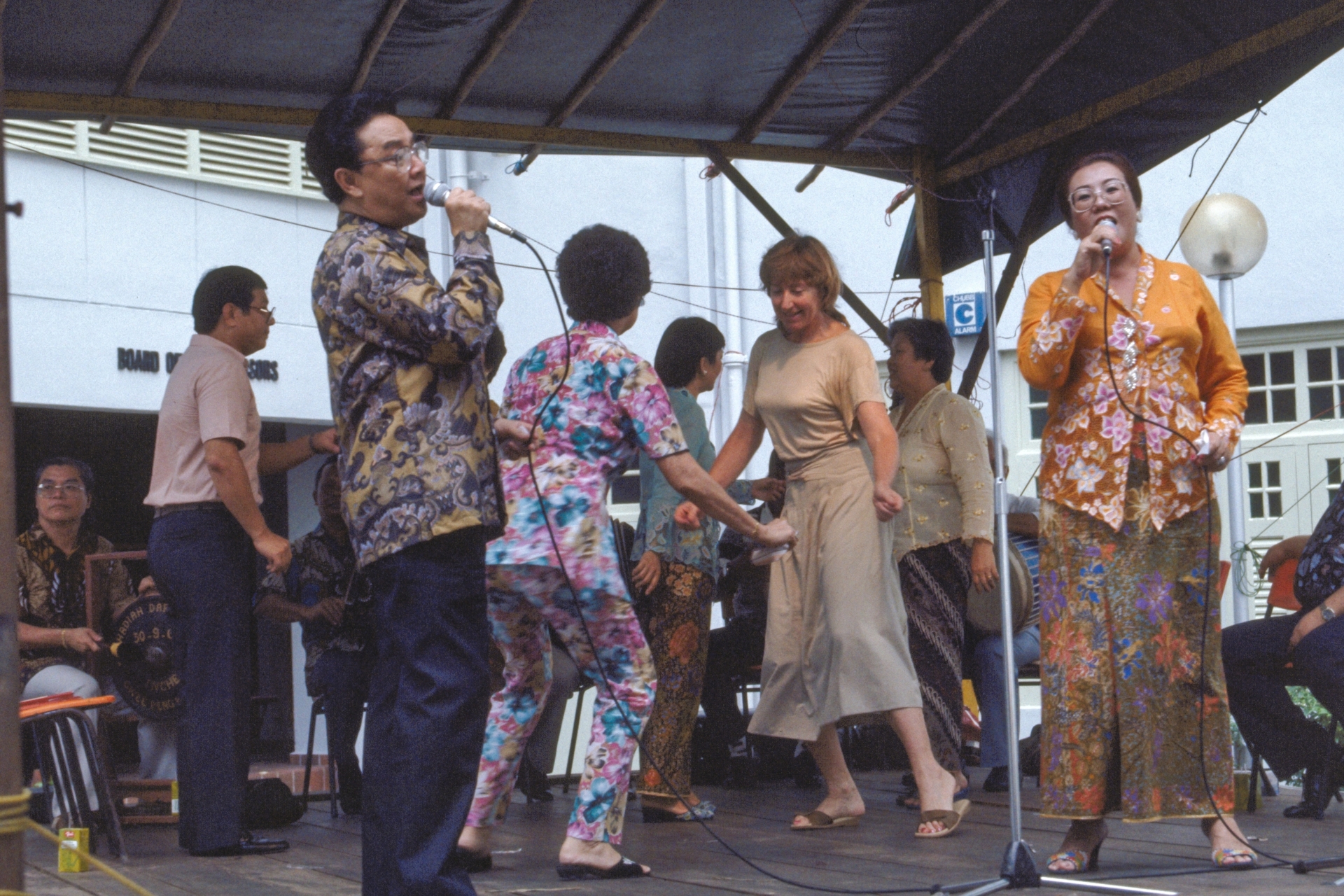
In the 1980s, the popularity of Chinese operas began to decline while Chinese orchestral music flourished. Lian continued to be deeply involved in the musical activities of the Nanyang Khek Community Guild, taking on the roles of musical director of the Han Music Ensemble, as well as resident arranger, assistant conductor, and cello instructor of the Chinese orchestra. He sought to elevate the musical performances by introducing the instrumentation and performance techniques of Chinese orchestral music to Han and folk music. His compositions fused elements of Han and folk music, making them more accessible to both the audience and music students, and became a unique draw in the Han music performances of the Nanyang Khek Community Guild.
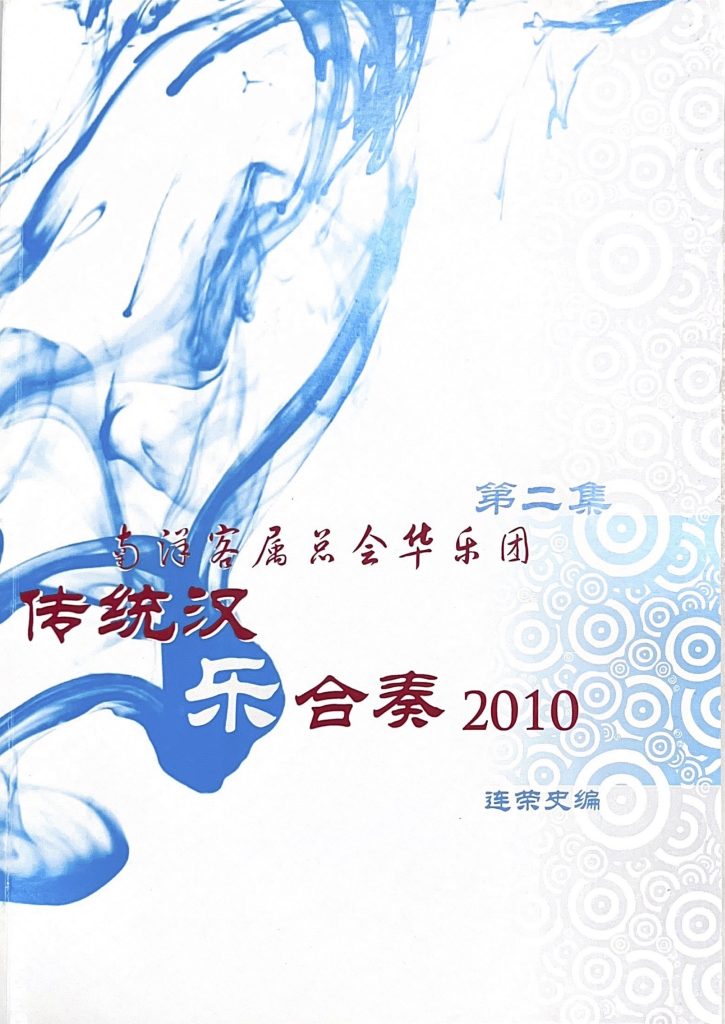
His canon — comprising musical arrangements and instrumental accompaniment — was compiled into four collections and published by the Nanyang Khek Community Guild. The titles were all released in 2011, including Chuantong hanyue 2010 (Traditional Han Music 2010), mainly a transcription of music from gongche notation into numbered musical notation; Chuantong hanyue hezou 2010 (Traditional Han Music Ensemble 2010), with updated arrangement and instrumentation; Shange yuequ hezou 2010 (Folk Music Ensemble 2010), with updated arrangement and instrumentation; Chuangzuo dahezou 2010 (Composition Ensemble 2010), which includes Chinese orchestra ensemble and local compositions. The fifth collection was Yueli jiben gainian jianjie (Introduction to Basic Music Theory). A further compilation, Chuantong hanyue hanyun zheng pu (Traditional Han Music Zheng Music Score), completed in 2012, has not been published.
Developing a new tihu
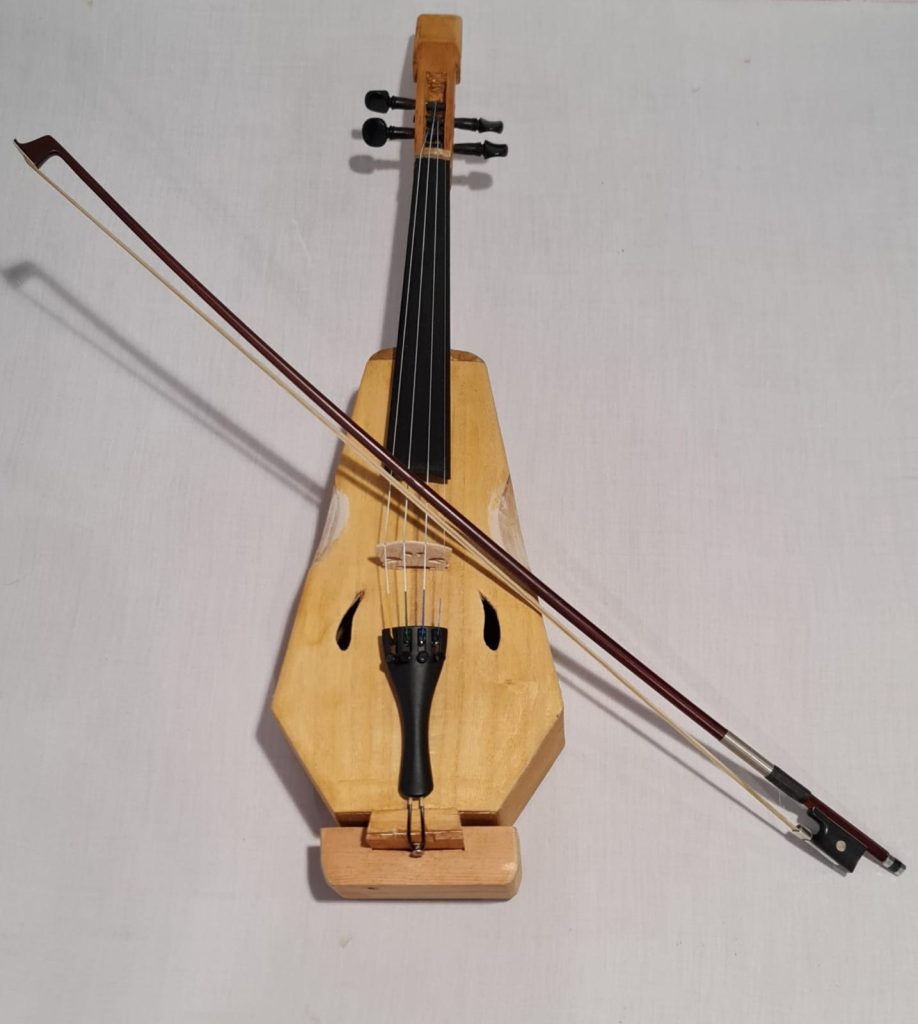
As the unsatisfactory timbre and soft volume of the high notes produced in the third position of the huqin affected the overall expression of the orchestra, Lian worked on developing a new version of the instrument tihu, known as the xin tihu for over 10 years. It was unveiled in 2024, alongside two new musical compositions by Lian that showcased its sound and performance. The new instrument is a four-string huqin inspired by two string instruments: the guoha, an instrument of the Miao minority people, and the traditional Uyghur khushtar. Its form, strings, and tuning are inspired by the violin (from low to high in the order of G, D, A, and E), and it also has a fingerboard and a resonance box to amplify the sound. With the bow set apart, the instrument is played upright like a cello. Despite producing an unconventional timbre, with a gliding effect that is not quite the same as that of the huqin, it allows for the use of the fourth position and has a five-octave range, producing high notes that sound steady and rich.
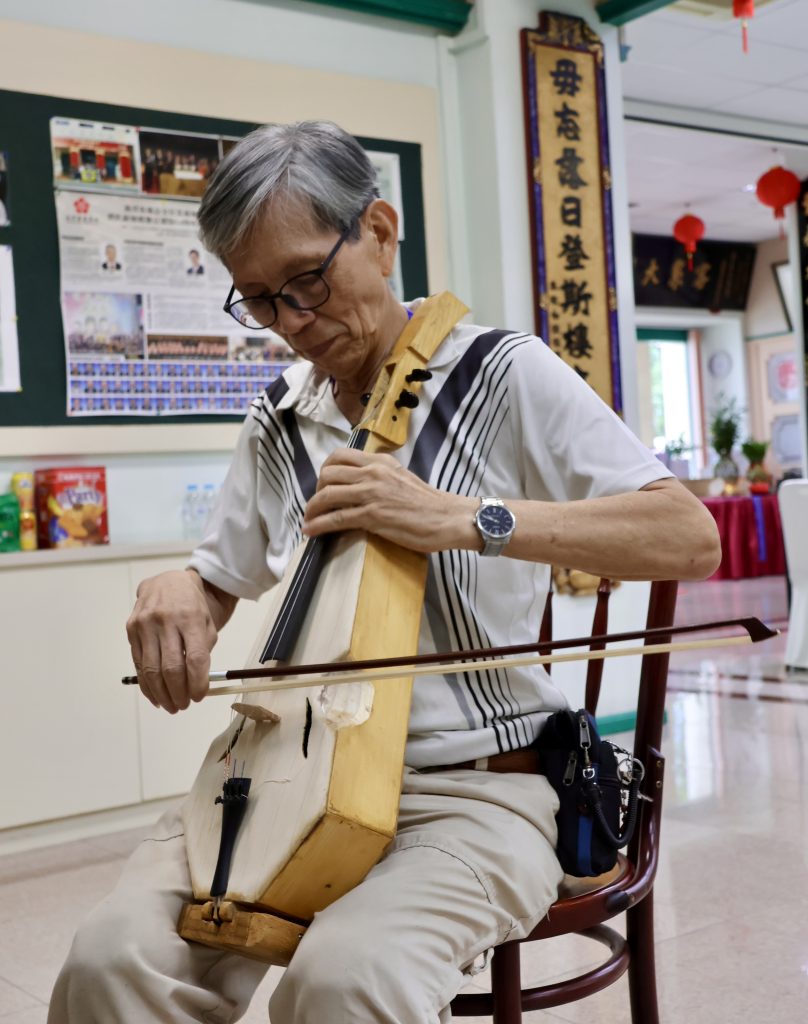
Lian is a multi-talented stalwart of Chinese orchestral music in Singapore. From his beginnings in Waijiang music to his transition to Chinese orchestral music, he has displayed the flair and talent of a natural born performer, highly skilled in both the guzheng and the cello, whether playing solo or in an ensemble. From the 1960s to the 1990s, he ran the Chung-Yi Music Centre, which focused mainly on teaching the guzheng and serving as a distributor of guzheng imported from China, playing an important role in promoting zheng music in Singapore. He also showed dexterity by taking on multiple roles in music arrangement, instrumentation, composing, conducting, and instrument improvement. These kept him active in the music scene, where he played with small and medium ensembles in the community. He also sought to promote traditional Han music and Chinese orchestral music by fusing the two in music arrangement and other community activities, thus maintaining the vibrancy of folk music.
This is an edited and translated version of 先驱音乐家:连荣史. Click here to read original piece.
| 1 | Nanyang Khek Community Guild was renamed Nanyang Hakka Federation in 2020. |
| 2 | The performance of Donghai yu ge (Fishermen’s Song of the Eastern Sea) marked the start of large-scale performances in Singapore’s Chinese orchestral scene. It premiered in 1963 at a concert jointly organised by Ai Tong and Chongfu Schools Alumni, listen to a recording from that performance here. |
Goh, Ek Meng. Xinjiapo huayue fazhan shilüe, 1953 nian zhi 1979 nian [The historical development of Singapore Chinese Orchestra, 1953–1979]. Singapore: Lingzi Media, 1998. | |
Kang Leh Musical Association, ed. Lishi de qingyin, Kangle yin yue yan jiuhui shiliu nian de yishu Shijian [Footsteps of History: 16 Years of Artistic Practice by the Kang Leh Musical Association]. Singapore: Tropical Literature and Art Club, 2011. | |
Lian, Yoong Ser, ed. Chuangzuo da he zou 2010 [Composition ensemble 2010]. Singapore: Nanyang Khek Community Guild, 2011. | |
Lian, Yoong Ser, ed. Chuantong hanyue 2010 [Traditional Han music 2010]. Singapore: Nanyang Khek Community Guild, 2011. | |
Lian, Yoong Ser, ed. Chuantong hanyue hezou 2010 [Traditional Han music ensemble 2010]. Singapore: Nanyang Khek Community Guild, 2011. | |
Lian, Yoong Ser, ed. Guzheng yanzou rumen [Introduction to Guzheng Performance]. Singapore: Vanguard Book Room, 1976. | |
Lian, Yoong Ser, ed. Shange yuequ hezou 2010 [Folk music instrumental ensemble 2010]. Singapore: Nanyang Khek Community Guild, 2011. | |
Lian, Yoong Ser, ed. Yueli jiben gainian jianjie [Introduction to basic music theory]. Singapore: Nanyang Khek Community Guild, 2011. | |
Zhong Yi Traditional Orchestra, blog. |